
Amsterdam is a stunning city. It has a village-like charm combined with the cosmopolitan vibe and cultural life of a European capital. What strikes me about Amsterdam is that it’s a city where traditions aren’t set in stone although it’s still Dutch at its heart. Compared to many other Dutch cities, including the Hague and Maastricht, it’s far more international and it’s more readily embraced English as a second language in many parts of the city.
Beyond that, Amsterdam’s cultural and social life is so varied and extensive – there are world-class museums, restaurants, theatres and concert halls, as well as so many unique cultural experiences such as canal-side concerts and large-scale outdoor festivals – that there is something for everyone to enjoy. The canals and historic neighborhoods also make for a beautiful, impressive environment to live and work in.
Riding A Bike In Amsterdam
In Amsterdam there are so many bikes it looks like – hard though this may be to imagine – the Tour de France for normal riders. It can be quite a stressful experience and almost resembles a cyclists’ free-for-all, with bikes zipping into any and every available space. At some point, I thought a motor scooter was going to ram me into a canal and by the time my group tour was up, I had definitely been verbally abused for halting abruptly in a cycle lane, and been loudly tooted and ringed at by incoming cars and cyclists for not going fast enough. Nevertheless, once I learned the rules of the road, cycling in the city became quite a blast.
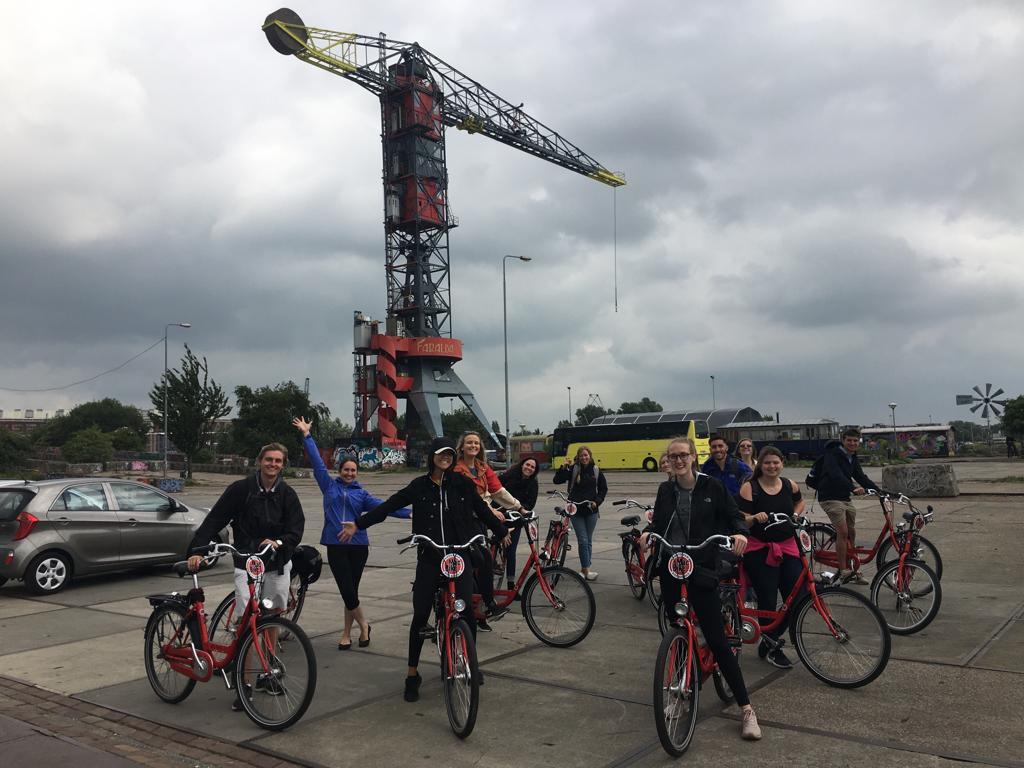
Sustainability Bike Tour
In Amsterdam, my International Environmental Law and Sustainability and Global Corporate Leaders class met at MacBikes to embark on a bike tour around the city. Upon arriving we met our tour guide, the founder of Sustainable Amsterdam, Cornelia Dinca. Throughout the tour Cornelia During told us about the different sustainability programs initiated throughout the city. She started with an introduction regarding the city’s history and how far it’s come to today, as far as sustainable efforts. We learned that by 2025 and 2030 the city of Amsterdam intends to prohibit diesel/gas transportation for busses and cars, respectively, and fully convert to electric transportation. This has already begun with their clean taxis and electric busses already available at Amsterdam Central station, along with the supporting infrastructure of over 2,000 electric charging stations. They have also created incentives for people to use sustainable modes of transportation such as bikes by increasing the price of parking in the city center from €5 to €7.50. To accommodate an increase in sustainable modes of transportation they have even begun construction on an underground parking garage for 10,000 bicycles.
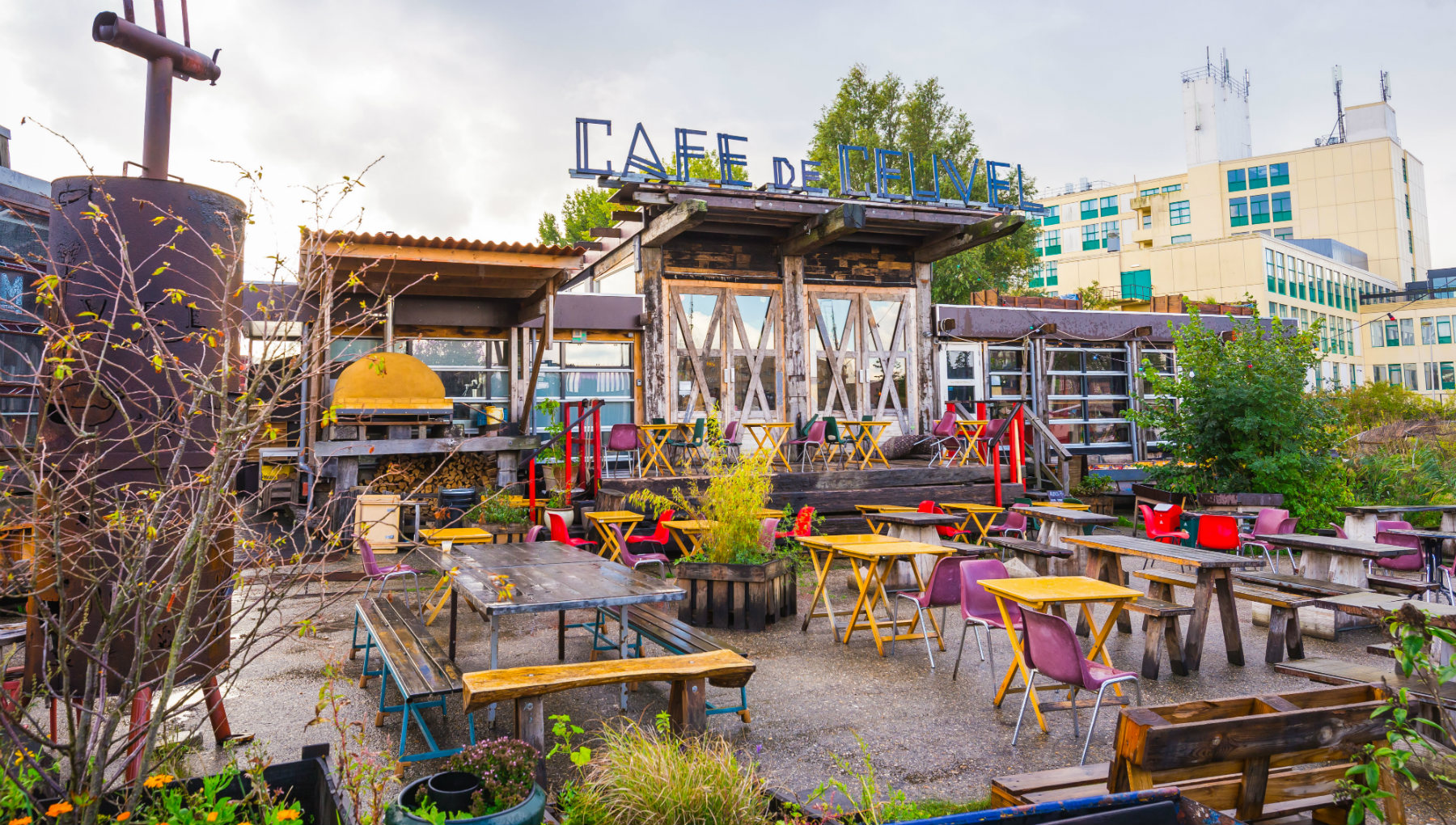
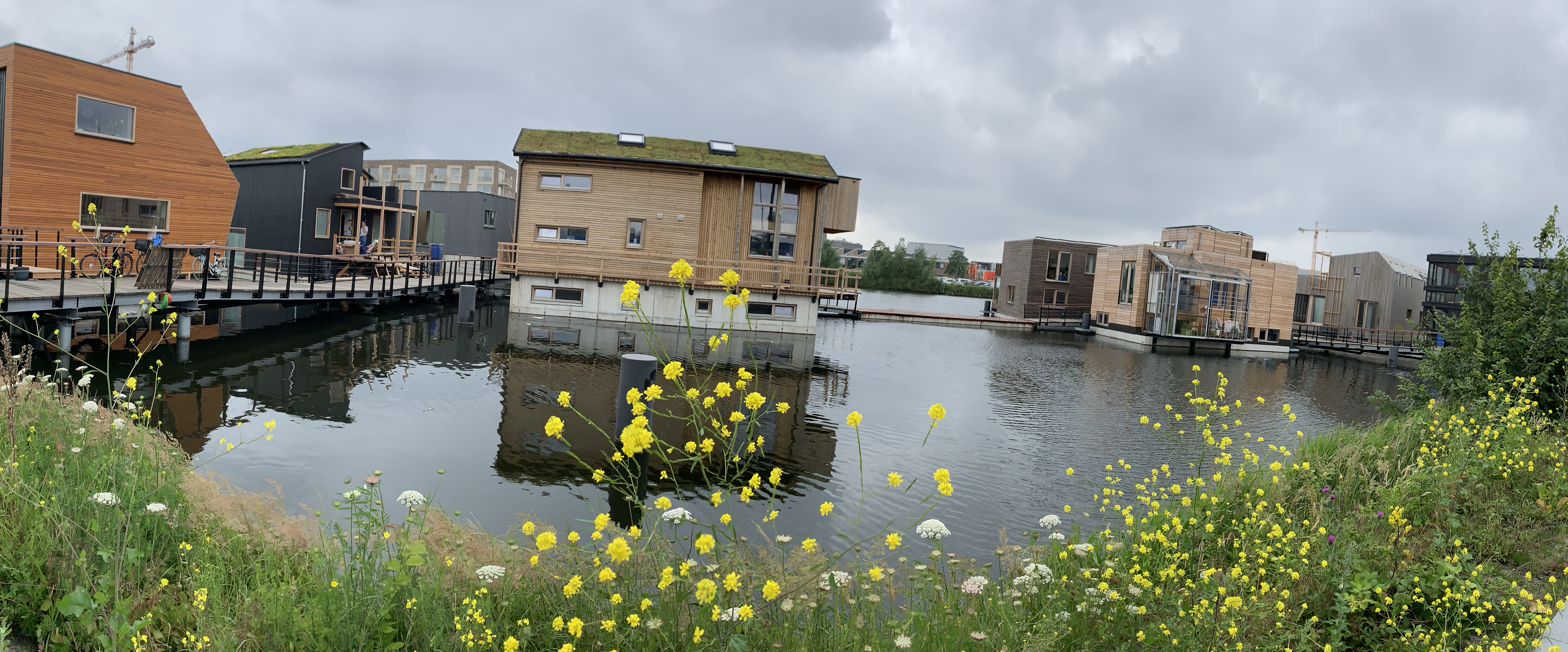
After giving us an introduction into the history of Amsterdam’s sustainable efforts, she took us to De Ceuvel, which is an award-winning, sustainable planned workplace for creative and social enterprises on a former shipyard on the Johan van Hasselt kanaal off the river IJ in Amsterdam North. While at De Ceuvel we learned that in 2012, the land was secured for a 10-year lease from the Municipality of Amsterdam after a group of architects won a tender to turn the site into a regenerative urban oasis.
The former industrial plot is home to a thriving community of entrepreneurs and artists, where all involved have lent a hand to build Amsterdam’s first circular office park. The plot hosts creative workspaces, a cultural venue, a sustainable café, spaces to rent, and a floating bed & breakfast.
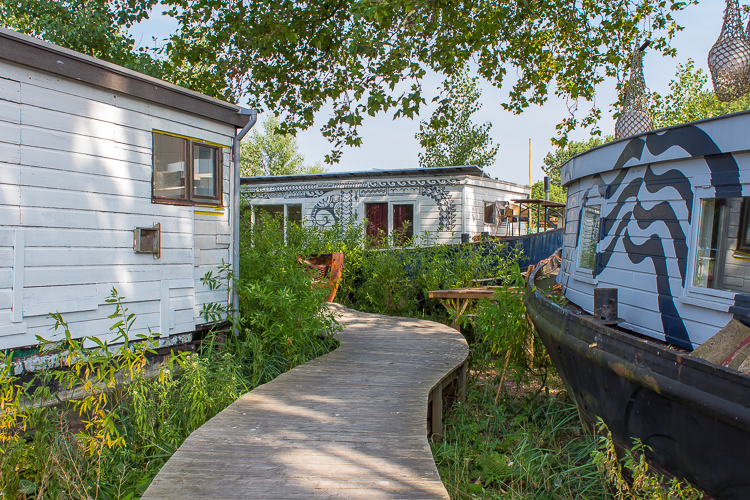
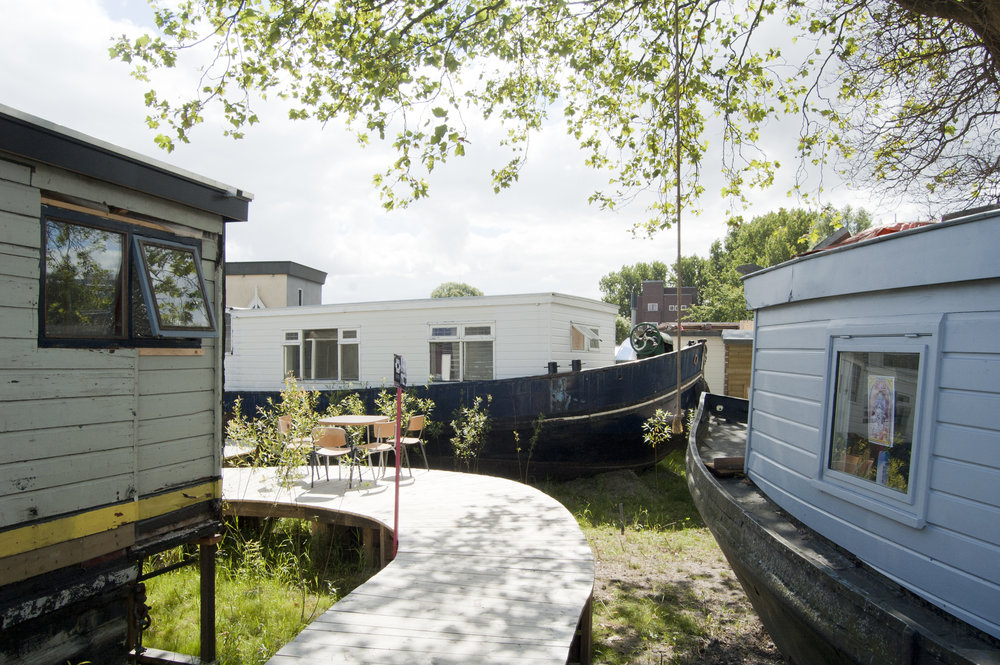
A highlight of the tour for me was learning that old houseboats, which have been placed on heavily contaminated soil, have been fitted with clean and sustainable technologies (connected by a winding jetty) making them as energy self-sufficient as possible to process waste in new, innovative ways. These houseboats, now used as workspaces, thus work in implementing sustainable energy efforts and cleaning the land it’s built on by up-cycling the top of polluted land through phyto-remediating plants, which work to clean the soil.
NDSM
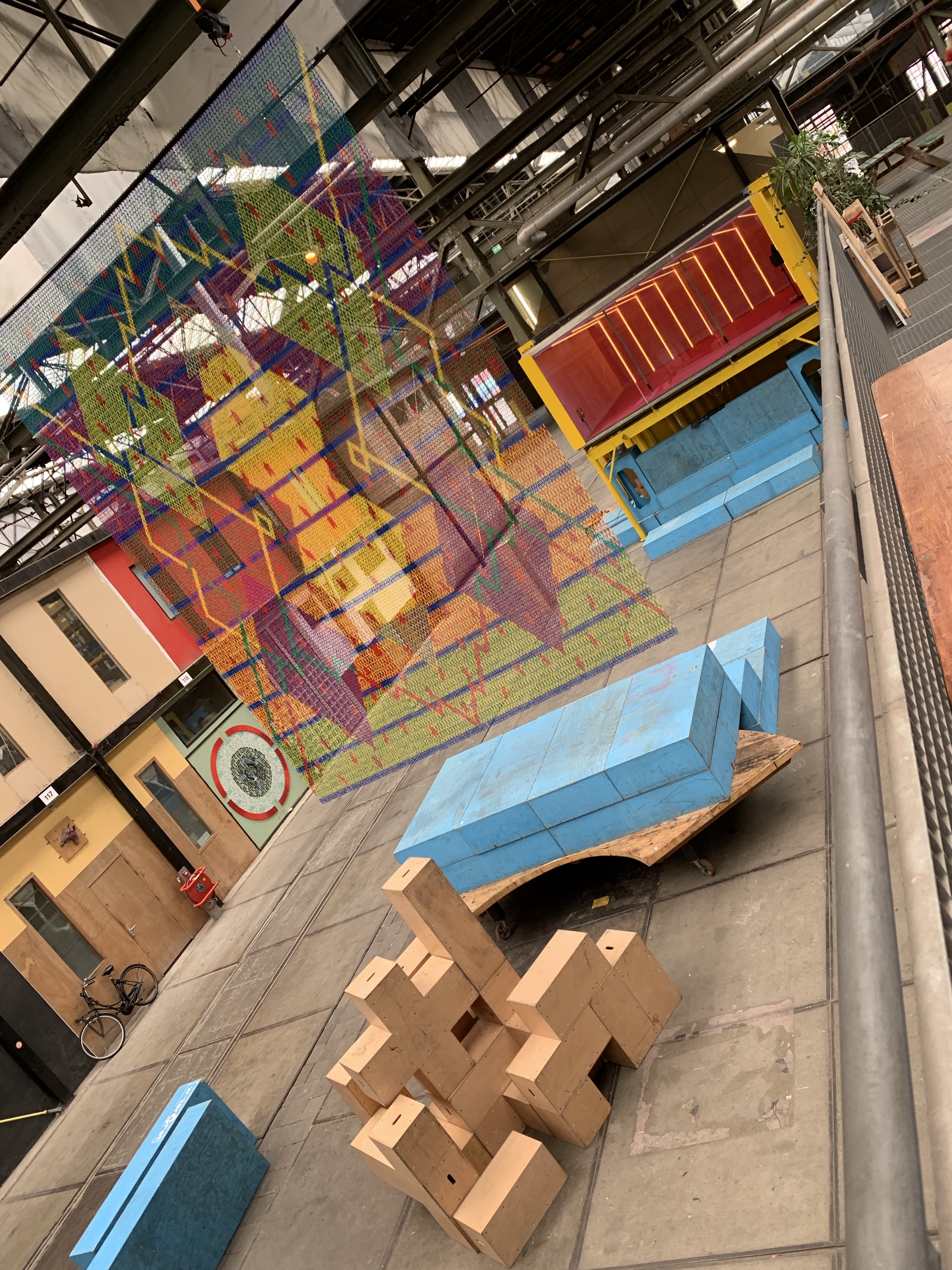
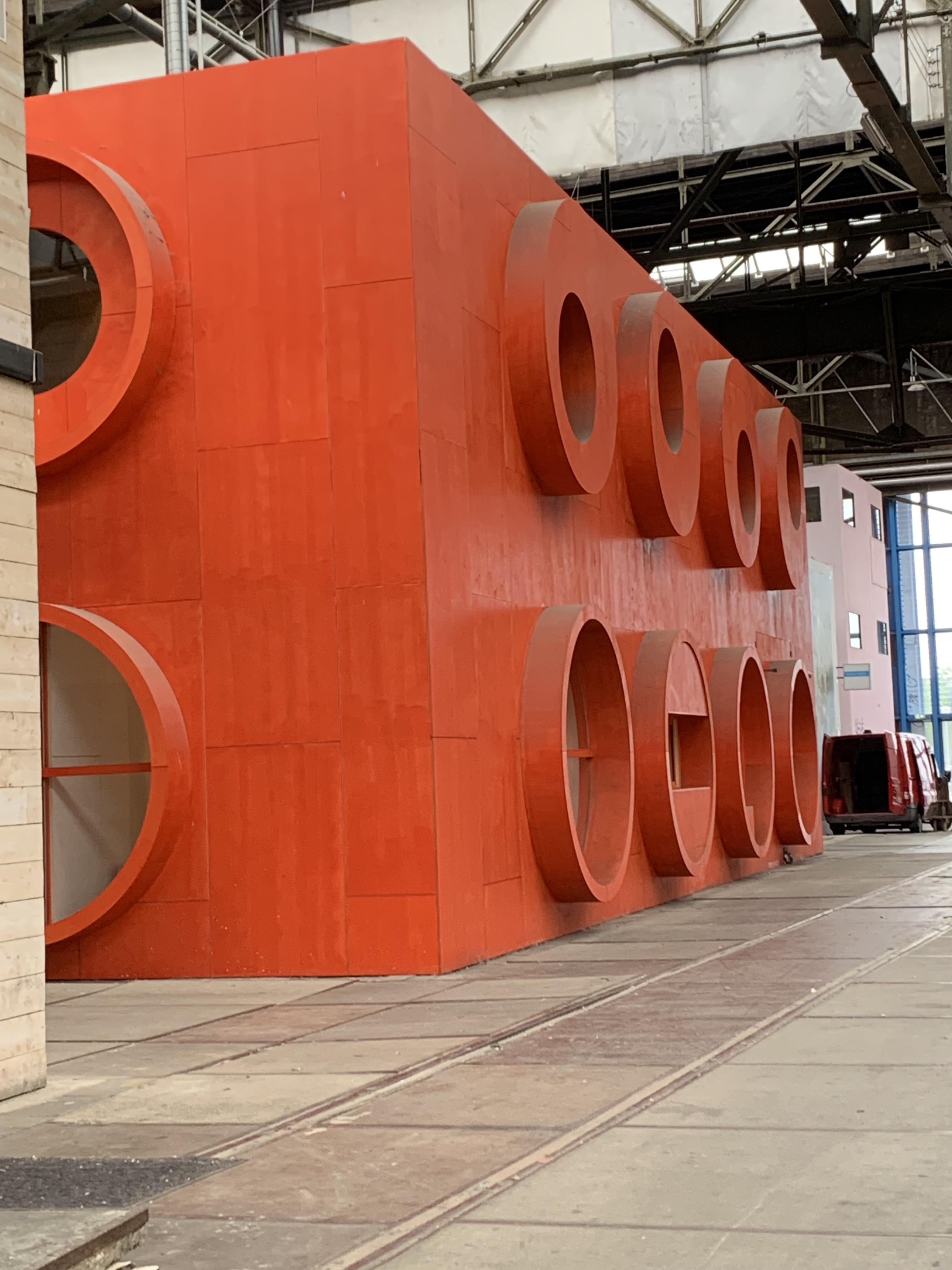
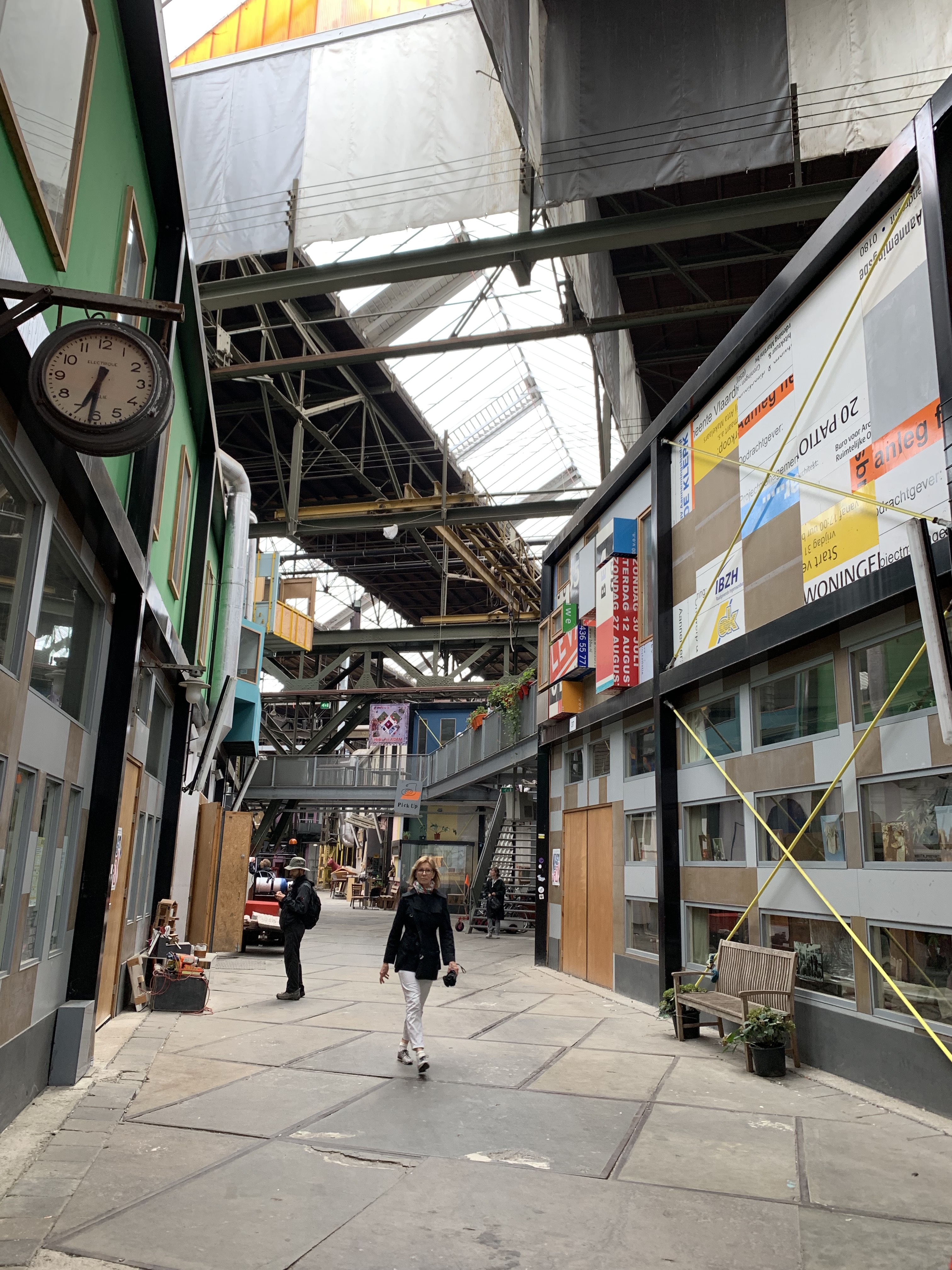
After the tour, Morgan and Danielle taught us more about NDSM. From the 1920s until the 1980s, the NDSM-wharf was one of the biggest shipyards in the world, regularly launching huge impressive tankers from its slipways. After this activity ceased, this sprawling location – and its imposing backdrop of crane tracks, sheds and the gigantic slipway – became a home port for creative pioneers after long disputes and negotiations with the artistic squatters living in the area who felt that the area’s pronounced, open and spatial character made the wharf attractive for creative experimentation, innovative ambitions, and entrepreneurship.
Today, the colossal shipbuilding shed is known as ‘Kunststad’ (‘Art City’), and is an architectural monument housing some four hundred artists, designers, architects and set designers. It is at NDSM that people can enjoy the largest street art museum, music festivals, restaurants made out of shipping containers, and a greenhouse that offer sustainable menu options.
Heineken
Lastly, Julian gave us some background history on Heineken and its CEO Jean-François van Boxmeer. Through Julian’s presentation I learned that Heineken is a Dutch brewing company, founded February 15, 1864 by Gerard Adriaan Heineken in Amsterdam. As of 2017, they owns over 165 breweries in more than 70 countries, produce 250 international, regional, local and speciality beers and ciders and employ approximately 73,000 people.
With an annual beer production of 188.3 million hectoliters in 2015, and global revenues of €20,511 billions in 2015, Heineken is the number one brewer in Europe and one of the largest brewers by volume in the world. Though its original brewery in Amsterdam, closed in 1988, it is preserved as a museum called Heineken Experience. Heineken’s Dutch breweries are can also be located in Zoeterwoude, ‘s-Hertogenbosch, and Wijlre.
Additionally, Heineken is one of eight companies in the Dutch Sustainable Growth Coalition (DSGC) which aims to drive sustainable growth by combining economic profitability with environmental and social progress. Through this coalition, Heineken has developed a sustainability program: Brewing A Better World.
Brewing a Better World is one of our six key business priorities. It focuses on six areas where they can make the biggest difference and inspires their brands to align their brand purpose with environmental and social issues. They are currently looking beyond 2020 as they raise their ambitions for the future, in line with the Paris Agreement on climate change (COP21), the UN Sustainable Development Goals and their conversations with stakeholders.
One of Heinekens biggest endeavors is to minimize their water footprint since water is a shared resource and essential for everyone on this planet and without water, Heineken wouldn’t exist (beer is 95% water). To do this, Heineken is promoting water recycling in their production processes in water-stressed areas. They’ve developed a new Governance Standard that helps their breweries upgrade their treated wastewater to drinking water quality, enabling it to be reused in a range of non-product applications. They also invest in water treatment plants and technology to reuse their treated water, as well as generate renewable energy from the treatment process.
Since 2008, Heineken has reduced average water consumption by 32%, down to 3.46 hl/hl, meeting their 2020 target. In water-stressed areas, average water consumption remained at 3.2 hl/hl, also surpassing their 2020 target. Additionally, 18 production sites in water-stressed areas have begun to implement water balancing action plans. As a result, Heineken has saved over €15 million in water efficiency with their sustainability efforts.
 Sarah's European Voyage